
Most people think confident speakers were born that way. They weren't. Almost everyone who speaks well in front of a group got there the same way: by standing up and speaking, again and again, until it stopped feeling strange.
That's good news, because it means confidence isn't a personality type. It's a skill, and like any skill, it grows with practice. The trick is to practise in small, regular steps instead of waiting for a big moment and hoping it goes well.
Here's a simple way to do that, one week at a time.
Why reading tips isn't enough
You can read a hundred articles on public speaking (including this one) and still feel your heart race when it's your turn. That's because nerves don't go away through understanding. They fade through experience.
The first time you speak in front of a group, everything feels unfamiliar: the faces looking at you, the silence before you begin, the sound of your own voice. By the fifth time, those things are familiar. Your body learns that nothing terrible happens, and the nerves get smaller. They rarely disappear completely, and that's fine. Even experienced speakers feel a little nervous. They've just learned to speak anyway.
A four-week plan to get started
Start small. Each week, add one new challenge.
Week 1: Speak for one minute
Introduce yourself to a group: your name, what you do, and one thing people wouldn't guess about you. One minute is enough. The goal isn't to be impressive. It's to stand up, speak, and sit down again, and notice that you survived.
Week 2: Answer a question you didn't expect
Ask a friend or your group to give you a simple question on the spot, like "What's the best meal you've ever had?" or "If you could live anywhere, where would it be?" Give yourself a minute to answer. You'll learn that you can think on your feet more than you believe. Our post on how to answer a question you didn't expect has a simple structure to help.
Week 3: Give a short prepared talk
Prepare a three to five minute talk on something you know well: your work, a hobby, a place you love, a lesson you learned the hard way. Keep the structure simple:
One main message. If people remember only one sentence, what should it be?
Two or three points that support it.
One short story from your own life. Stories are easier to remember than facts, for you and for the audience.
Practise it out loud two or three times before the day. Don't memorise it word for word; know your points and let the words come.
Week 4: Take a role instead of a speech
Speaking isn't the only way to practise. Try timing the speakers, or giving another speaker feedback. Listening closely and then sharing what you noticed builds a different kind of confidence: the confidence to speak up in meetings, guide a discussion and say what you think.
Small habits between meetings
A weekly meeting is the main practice. These small habits help in between:
Say one opinion out loud every day. In a class, a work meeting or a family conversation, share one clear thought instead of staying quiet.
Record yourself for 60 seconds. Talk about your day into your phone, then listen back once. It feels awkward at first, and that's the point.
Read aloud for five minutes. A newspaper article or a page from a book. It gets you used to the sound of your voice.
Pause instead of filling silence. When you'd normally say "um" or "basically", try a short pause instead. Pauses sound more confident than filler words.
When the nerves show up anyway
They will, especially in the first few weeks. A racing heart, shaky hands or a dry mouth doesn't mean you're bad at this. It means you care. Slow breathing, arriving early and knowing your first sentence by heart all help. We wrote more about this in five ways to calm your nerves before a speech.
Use feedback to keep improving
Practice helps most when someone tells you what they noticed. After you speak, ask for two things (and if you are the one giving feedback, here is how to give feedback that helps, not hurts):
One thing to keep, something that worked well.
One thing to try next time, a single, specific change.
Only one change at a time. Trying to fix everything at once is overwhelming; fixing one thing each week adds up quickly.
Keep a simple record
After each time you speak, write down three lines: what you spoke about, how nervous you felt from 1 to 10, and the one thing you'll try next time. After a month, read it back. Most people are surprised by how far they've come, because progress is hard to notice while it's happening.
Practising in English
If English isn't your first language, speaking in English in front of others can feel twice as hard. The same rule applies: regular practice in a friendly room makes it easier. Mistakes in grammar or words are normal and part of learning. People listen for your ideas, not for perfect sentences.
Practise with us
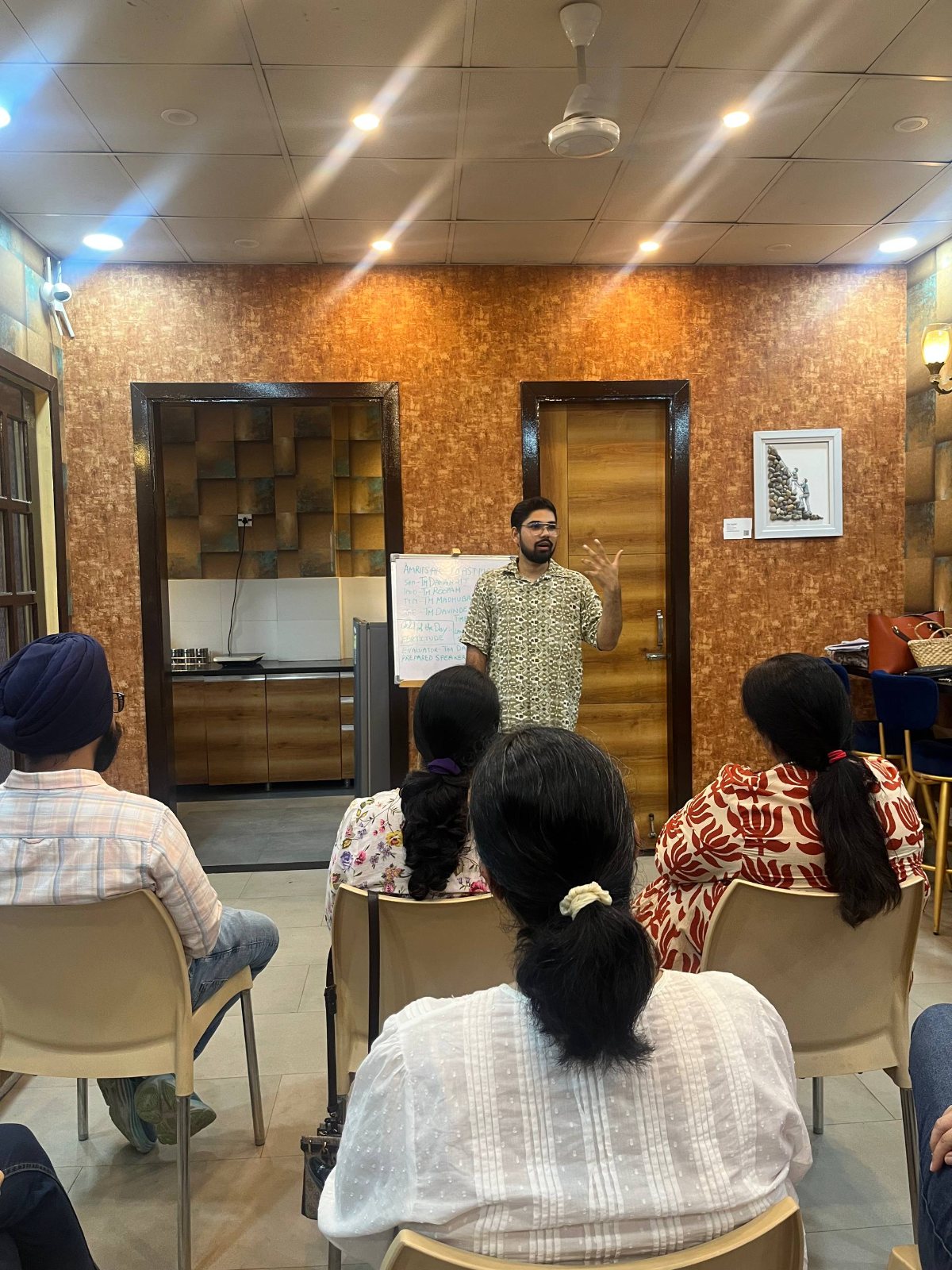
This is exactly what we do at Amritsar Talkmasters. Every Saturday from 4 to 6 PM, people meet in Amritsar to give short speeches, answer surprise questions, give each other feedback and take turns running the meeting. Meetings are in English, beginners are welcome, and people from nearby towns are welcome too.
See what a meeting looks like, or come to your first one. You don't need to be a good speaker to walk in. You only need to be willing to stand up.